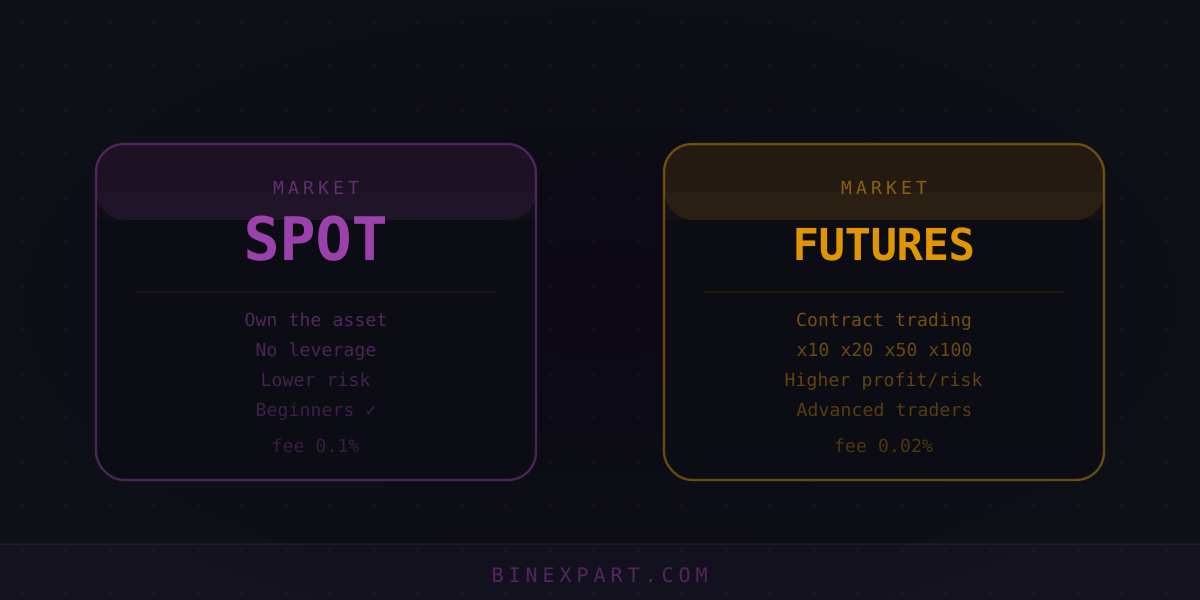
After the Basics — the Second Wave of Futures Questions
I have been trading since 2018. In the basics article I explained the core spot/futures difference and warned about leverage risks. But there is a second wave of questions — from people who understand the basics and ask: "what is a funding rate and why am I being charged every few hours", "how do traders hedge positions", "why would anyone short if the whole crypto market grows long-term". This article is for that second wave.
Before You Continue
If you are not yet familiar with the basic spot/margin/futures difference, start with trading basics. This article assumes you already understand long/short and liquidation.
Funding Rate: Why It Is Not an Exchange Fee
Perpetual futures (no expiry date) have a mechanism that keeps the contract price close to the spot price — the funding rate. This is a periodic payment (usually every 8 hours) between traders, not to the exchange.
- Positive funding rate (more common in bull markets): longs pay shorts. More people long → futures price above spot → the mechanism "penalises" longs to rebalance.
- Negative funding rate (more common in bear markets): shorts pay longs.
Practical example: a $10,000 long position with a 0.01% funding rate every 8 hours = $1 every 8 hours = $3/day = $90/month in payments. Holding a position for weeks, these payments accumulate and can exceed the profit from price movement.
When Funding Rate Matters
| Strategy | Funding rate impact |
|---|---|
| Intraday trading (hours) | Minimal — position closes before the next payment |
| Holding for weeks | Significant — can eat 5-15% of profit in a bull market for longs |
| Hedging (below) | Can work in your favour — you receive funding instead of paying it |
Before opening a long-term position, check the current funding rate in the futures interface — if it is consistently high against you, holding will cost more than the headline fee.
Hedging: When a Short Is Not a Bet Against the Market
The biggest beginner misconception: "why would anyone short if the market is rising". The answer is that hedging is not always a bearish bet — often it is insurance for a spot position.
Example: you hold 1 BTC on spot (long-term, do not want to sell for tax/strategy reasons). You expect short-term volatility before an important event (e.g. a central bank decision). You open a 1 BTC short on futures.
- If BTC drops 10% → the spot position loses $X, but the short gains ~$X → net result near zero
- If BTC rises 10% → spot gains $X, short loses ~$X → also near zero
The result: you "freeze" the value of your BTC during a period of uncertainty without physically selling it. This is not speculation — it is risk management for a long-term holder.
Basis Trading: a "Risk-Free" Delta-Neutral Strategy
An advanced strategy used by funds: simultaneously buy on spot and open a short on futures for the same amount (a delta-neutral position — price movements do not affect the overall result). Profit comes purely from the positive funding rate received on the short position.
At a 0.01% funding rate every 8 hours, that is roughly 11% annualised — without directional price risk (but with risks: exchange counterparty, execution risk, and the possibility of funding turning negative).
Not for beginners, but useful to know it exists — funding rate is not a "random number" but the foundation of entire trading strategies.
Decision Framework: Spot or Futures for Your Goal
| Goal | Instrument |
|---|---|
| Long-term accumulation (HODL) | Spot |
| Short-term bullish speculation | Spot (no leverage) or futures with minimal leverage |
| Profiting from a price decline | Futures (short) — impossible on spot |
| Protecting a spot position from short-term volatility | Futures (hedge short), without selling spot |
| Passive income from funding | Basis trading (advanced level) |
Bottom Line
The funding rate is not a fee but a market-balancing mechanism that can cost or pay you depending on your position direction and market sentiment. Hedging with futures is a risk management tool for spot asset holders, not just speculation. If these concepts feel complex, return to the basics and practise on spot longer before coming back here.